


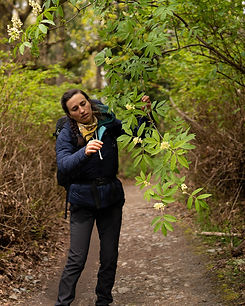
Natalie Hammerquist
Author, herbalist, educator
About
I’m an herbalist, teacher, and plant-based maker born and raised in the Seattle area, now based in Roslyn, Washington, in the Upper Kittitas County region on the historic treaty territory and ancestral lands of the Confederated Tribes and Bands of the Yakama Nation.
My work is rooted in a lifelong relationship with the plants and landscapes of the Pacific Northwest, and in a deep interest in how direct, hands-on engagement with plants changes the way we belong to place.
I studied herbalism, plant taxonomy, and food science at The Evergreen State College, and later apprenticed with herbalist Cascade Anderson Geller in Portland, Oregon. I’ve continued learning through a range of teachers in Western herbal traditions, including Matthew Wood, Dr. Sheila Kingsbury, Missy Rohs, and Margi Flint.
Before founding the Adiantum School of Plant Medicine in 2016, I worked as the lead herbalist and bulk herb buyer at Rainbow Natural Remedies in Seattle. Since then, I’ve taught thousands of students throughout the Pacific Northwest and online.
Over time, my work has expanded beyond herbalism alone. I’m deeply drawn to plants as materials for making — medicine, food, natural dyes, fibers, and craft. I see this as an extension of something I’ve always known about myself: I’ve been a maker since I was young, and working with plants in a hands-on way feels like a natural continuation of that.
What interests me most now is the way relationship forms through practice. When we harvest, process, and make with plants directly, our relationship to land shifts. We don’t just learn about plants — we begin to feel connected to the places they grow. I’ve seen again and again how this changes people: attention deepens, care increases, and the land stops feeling abstract. It becomes personal.
I’m also interested in the feeling of belonging that grows from this kind of direct relationship. People tend to care more deeply about places they know through experience. They notice changes. They feel loss more sharply when landscapes are altered. And they often feel more grounded and alive when they are actively engaged with the land around them.
My teaching is hands-on, sensory, and rooted in direct engagement with plants in their environments. I’m less interested in plants as information, and more interested in plants as living relationships shaped through attention, season, and use.
Learning, Land & Lineage
I approach plant work as something that is always rooted in place and relationship. Much of what I work with in the Pacific Northwest exists within a long history of Indigenous relationship with this land. I hold that awareness with respect, humility, and care.
As a non-Indigenous maker and teacher working within Western herbal traditions, I continue to reflect on what it means to learn from, work with, and share knowledge of plants in this region responsibly. This is an ongoing practice for me rather than a fixed position.
My hope is to support people in developing their own direct relationship with plants — through making, observation, and time on the land — in ways that feel grounded, meaningful, and real.
Books & Projects
I’m the author of Medicinal Plants of the Pacific Northwest and Edible Plants of the Pacific Northwest, both richly illustrated field guides focused on identification, harvesting, preparation, and safe use of common regional plants.
My third book, Winter Twigs of the Pacific Northwest, focuses on identifying deciduous trees in winter and is scheduled for release in Fall 2026.
I continue to explore plant relationships through writing, teaching, photography, and making, and I share my work through in-person classes, YouTube, and Patreon.
I live with my husband in Roslyn, where I spend much of my free time hiking, skiing, climbing, foraging, and making things outside.